Mail

ardsihyd@gmail.com

Help Line (10:30 am - 5:00 pm IST, Mon - Sat)

+91 91211 06681

Alzheimer’s and Related Disorders Society of India – Hyderabad Deccan Chapter (NGO)

Treatment & Management

Early diagnosis, comprehensive assessment, and compassionate care

As part of a comprehensive dementia assessment. Dementia treatment and management begins with one essential step: eliminating every possible reversible cause of memory loss and cognitive decline. We follow an evidence-based, person-cantered approach that prioritizes accurate diagnosis, timely intervention, and long-term support for individuals and families.”

Eliminate Every Possible Cause of Cognitive Decline

Not all memory problems are dementia. Many conditions can mimic or worsen dementia symptoms—and some are treatable.
As part of a comprehensive dementia assessment, we screen for:
  • Vitamin deficiencies (especially Vitamin B12 and folate)
  • Thyroid and metabolic disorders
  • Depression, anxiety, and stress-related cognitive impairment
  • Infections and inflammatory conditions
  • Medication side effects and polypharmacy
  • Sleep disorders such as sleep apnea
  • Vision and hearing impairment
  • Dehydration and nutritional deficiencies
  • Traumatic Brain Injury and other organic causes
Identifying and treating these conditions can delay progression, improve functioning, or even reverse symptoms in some cases.

Accurate Diagnosis: Understanding the Type and Stage

Once reversible causes are ruled out, accurate diagnosis is essential for effective dementia management.
We assess:
Types of Dementia: Alzheimer’s disease, vascular dementia, Lewy Body Dementia, Frontotemporal Dementia , Parkinson’s disease and others.
Stage of dementia progression Physical health, mental health, and social factors.
A clear diagnosis allows families to plan ahead and access the right treatment at the right time.

Medical Treatment: Managing Symptoms, Not Just Disease

While there is no cure for most dementias, medical interventions can help manage symptoms and improve quality of life.
Treatment plans may include:

Medications to support memory, attention, and daily functioning

Management of behavioral and psychological symptoms

Ongoing medication reviews to reduce side effects and unnecessary drugs

Medical treatment works best when combined with non-drug interventions and supportive care.

The Non-Drug Interventions in Dementia Care

Cognitive stimulation therapy or CST is a non-pharmacological, evidence-based approach to treat the complex behavioural and psychological symptoms {BPSD}seen in patients with dementia. BPSD can range from mood changes, disruptive behaviours, hallucinations, aggression, agitation, sleep disturbance, motor changes, apathy, depression, and memory loss.
CST was developed in the UK by Dr. Spector and her team. It is recognized by the National Institute of Health and Clinical Excellence (NICE, UK) as an evidence-based psychosocial intervention for the management of mild to moderate dementia which helps to improve patient confidence, cognition, social interaction, and quality of life.
They are delivered both as individual sessions and as group activities:

Reminiscence

Music therapy

Art and Craft

Speech and Language

Physiotherapy

Pet Therapy

Cooking

Aroma Therapy

Gardening

Art & Craft Therapy

Gardening Therapy

Cooking Therapy

CST

Aroma therapy

Reminis cence

Music Therapy
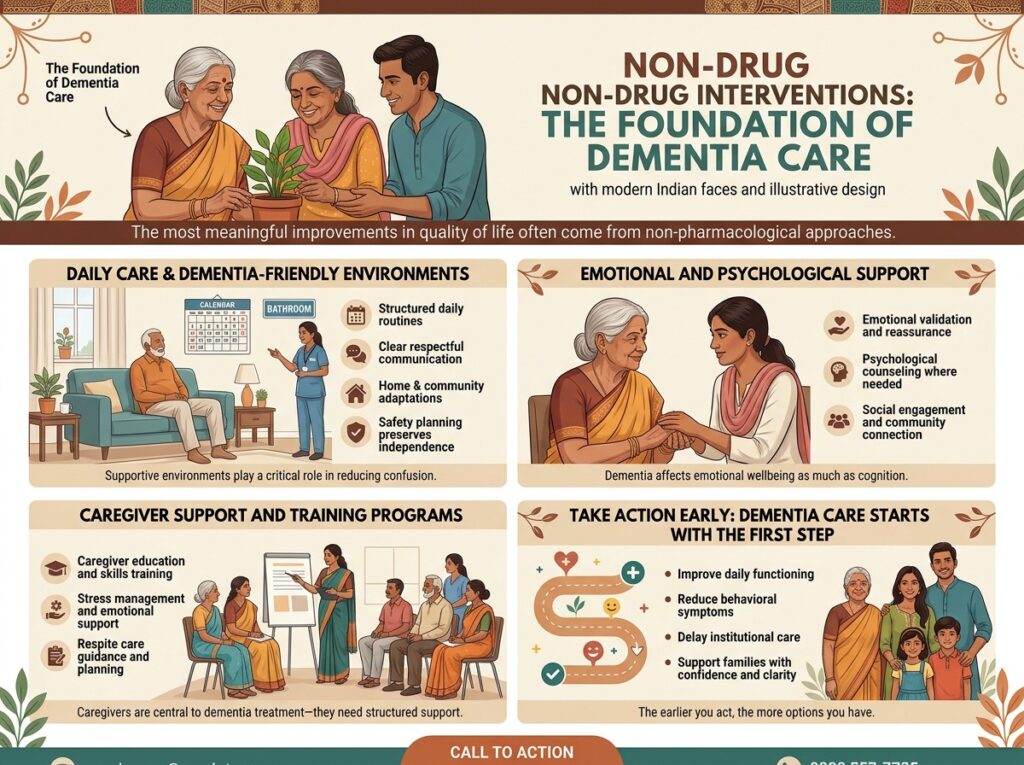
4. Non-Drug Interventions
The Foundation of Dementia Care

The most meaningful improvements in quality of life often come from non-pharmacological approaches.
Daily Care and Dementia-Friendly Environments

Supportive environments play a critical role in reducing confusion and agitation.

Key strategies include
  • Structured daily routines
  • Clear, respectful communication
  • Dementia-friendly home and community adaptations
  • Safety planning that preserves independence

Thoughtful care planning helps prevent crises and hospitalizations.

Emotional and Psychological Support

Dementia affects emotional wellbeing as much as cognition.

We emphasize:
  • Emotional validation and reassurance
  • Psychological counseling where needed
  • Social engagement and community connection

Supporting emotional health improves overall dementia outcomes.

Caregiver Support and Training Programs

Caregivers are central to dementia treatment and management—and they need structured support.

We offer:
  • Caregiver education and skills training
  • Stress management and emotional support
  • Respite care guidance and planning

Supporting caregivers reduces burnout and improves care quality.

Take Action Early: Dementia Care Starts with the First Step
Early dementia treatment and management can:
  • Improve daily functioning
  • Reduce behavioral symptoms
  • Delay institutional care
  • Support families with confidence and clarity

The earlier you act, the more options you have.